
Everything's changed because of AI. Except it hasn't.
What two cybersecurity veterans, some badly behaved robot dogs and 19 ping-pong balls have to do with AI security.
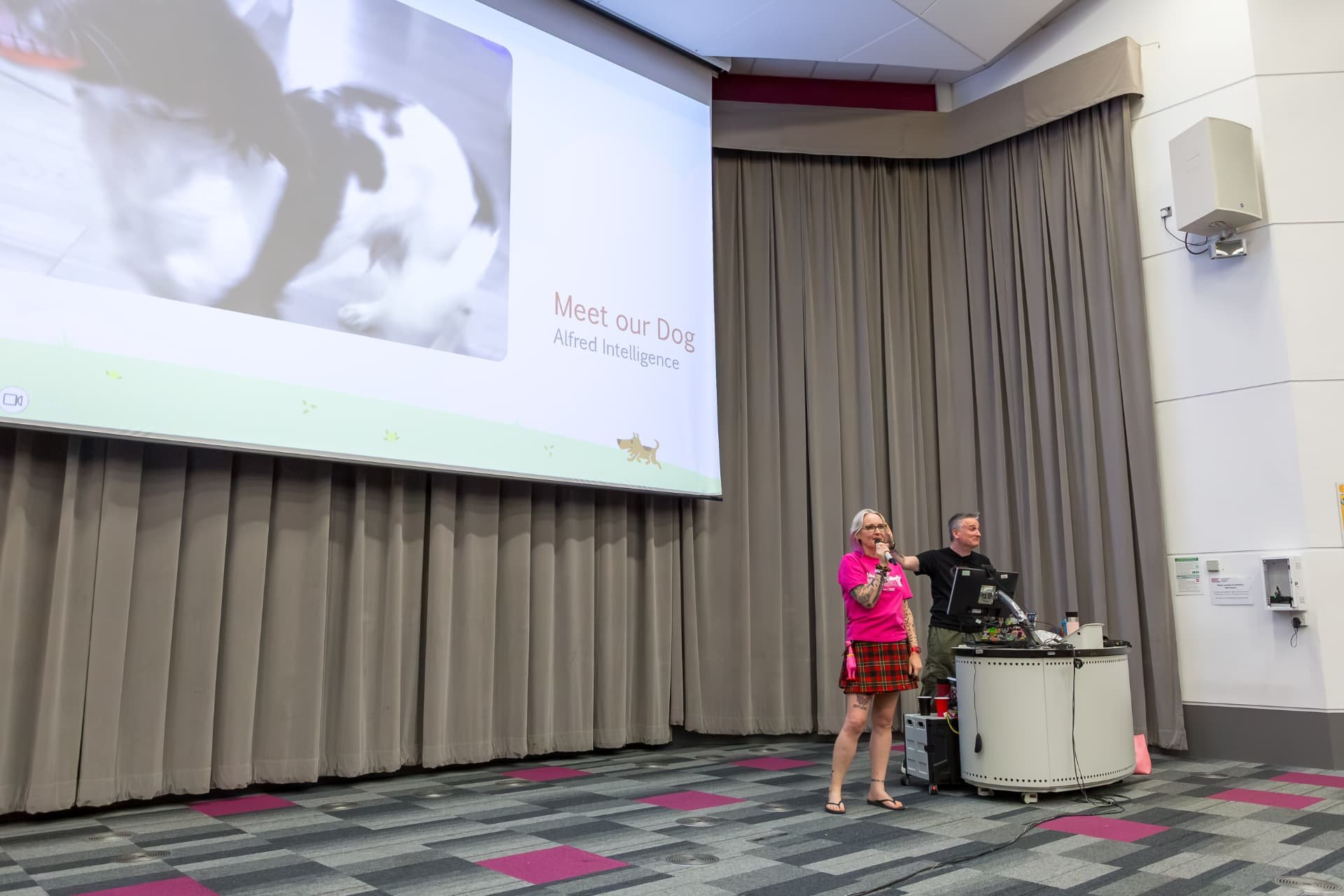
Depending on what floats your boat, there might be better ways to spend a Saturday afternoon than watching two cybersecurity veterans attempt to demonstrate the benefits and risks of artificial intelligence using robot dogs, ping-pong balls and a presentation that was, at least in part, written by AI.
But SteelCon 2026 gave us the closing slot, so that's what the folks who decided that was their Saturday afternoon duly received.
Our talk, Ey I Up, Pal: Dead Fast, Reyt Spurious, And A Wee Bit Brutal, was an attempt to make sense of some of the more ridiculous aspects of AI adoption, alongside the rather serious security implications of letting increasingly capable technology loose on systems and data we care about.
We brought props. We recruited volunteers. We subjected the audience to live demonstrations with absolutely no guarantee that anything would behave as intended. We even let AI write a substantial chunk of the presentation, which was an enlightening experience for everyone involved.
And somewhere amongst the chaos, we had a point to make.
AI is changing an enormous amount about how we work, what we can build and how quickly we can do it. Some of it is genuinely extraordinary.
But the suggestion that it has somehow rewritten everything we know about cybersecurity? That's a bit of a stretch.
The solution looking for a problem
One of the more entertaining things about the AI boom is how quickly we've gone from asking what technology could help us achieve to being told we need AI because everyone else has it.
Businesses are under enormous pressure to adopt it. Investors want to see it. Executives want to talk about it. Vendors would quite like you to buy whatever they've recently rebranded to include it.
And the business problem we're supposed to be solving?
Well, we'll get to that.
This was the premise behind one of our live experiments. We recruited Rory from the audience, gave him the components of a toy dog and informed him that he was now building an agent.
Throughout the talk, we checked on his progress. Was it ready yet? Where was the business value? Did he need training? We'd already provided training, so why wasn't it delivering results?
At no point had we established what success was supposed to look like, but that didn't stop us demanding it.
Entirely fictional executive behaviour, of course. Nobody would ever introduce a new technology, fail to explain what it's meant to achieve and then become frustrated when the expected benefits don't materialise.
Ahem.
The problem isn't that businesses want to use AI. There are excellent reasons to explore what it can do.
The problem is treating AI adoption as an outcome in itself, rather than working out what you're trying to accomplish and whether AI is the right way to get there.
Everything is faster. Including the mistakes.
There's a lot of talk about how AI has fundamentally changed cybersecurity, and certainly there are new capabilities, attack surfaces and behaviours that we need to understand.
But let's consider what hasn't changed.
Data is still data. Identity and access still matter. Suppliers still introduce risk. Software can still be badly designed, insecure or given permissions it has absolutely no business having. And people are still capable of making spectacularly poor decisions.
AI hasn't made any of that disappear.
What it has done is make some of those decisions much easier to execute, at a scale and speed we haven't previously had to contend with.
Take AI-assisted development. There's an enormous opportunity to make software engineering more productive, and we're already seeing people build things that would previously have been beyond their technical abilities.
That's genuinely exciting.
It's also worth considering what happens when someone who doesn't understand software security can build and deploy an application, connect it to company systems and start processing sensitive information without necessarily recognising the risks they've introduced.
The absence of a traditional development bottleneck isn't automatically an improvement if the things that bottleneck helped protect against have simply been bypassed.
AI-specific vulnerabilities also deserve attention. Prompt injection, for example, presents challenges that aren't identical to traditional injection attacks, particularly where models are interpreting instructions and making decisions about which tools to use.
But the underlying questions about trust, access and what happens when untrusted input influences a system's behaviour should be familiar to anyone who's worked in security for more than five minutes.
We've got new things to learn. That doesn't mean we should forget everything we already know.
But we've got guardrails!
There are certain words in technology that seem to acquire magical properties, and guardrails is rapidly becoming one of them.
Mention guardrails in a conversation about AI security and everyone can relax. The risks have apparently been dealt with.
Except that guardrails can mean an extraordinary number of different things, from controlling what a model can access to trying to influence what it will say, and they don't all offer the same level of protection.
Imagine taking your children to play beside a cliff.
You've installed a guardrail, so everything is fine.
Except occasionally the guardrail isn't there. Sometimes it doesn't work. Sometimes it breaks when someone leans on it.
Would you consider that an acceptable safety measure?
Probably not. And yet we're remarkably comfortable accepting vague assurances about AI controls without always examining what those controls actually do, how reliably they work or what happens when they fail.
This isn't an argument against building controls around AI. Quite the opposite.
It's an argument for understanding them.
What are we trying to prevent? How does the control work? What are its limitations? How do we test it? What happens when it doesn't behave as expected?
Those questions aren't particularly glamorous, but they'll tell you considerably more about your exposure than the word guardrails ever will.
Can I ship it?
For the second half of the talk, we let AI generate a series of scenarios involving the sort of things organisations are increasingly keen to do.
AI-assisted coding. Marketing automation. Employee-built applications. Productivity tools with access to company documents and systems.
The audience had to decide whether we'd ship them.
Naturally, the answer to most cybersecurity questions is it depends, but that's not nearly as entertaining as making people commit to a yes or no.
Consider the marketing assistant.
It can produce content, analyse information, automate communications and generally make the marketing department more productive. So far, so good.
Now give it access to the CRM.
Suddenly we have some additional questions. What personal information can it access? Where is that information going? What contractual arrangements are in place with the supplier? What can the agent do without someone reviewing its actions?
And what happens when it sends a load of inappropriate emails to people who weren't supposed to receive them?
As the marketing person in this particular double act, I can confirm that marketing already has enough opportunities to annoy people without giving an AI agent unrestricted access to the database.
The same problem appears in engineering, operations and pretty much every other department.
The technology may be entirely capable of performing a task. That doesn't establish that we've configured it safely, given it appropriate permissions or understood the consequences of letting it operate independently.
There's a difference between something working and something being ready for production.
And the faster we can build things, the easier it becomes to confuse the two.
Meanwhile, the dogs weren't cooperating
We decided that the most appropriate way to explain different AI capabilities was to represent them using dogs.
Obviously.
There was Bluey, representing a friendly chatbot. There was a small robotic puppy whose behaviour was unpredictable enough that we were slightly concerned about its physical integrity. And there was a much larger robot dog, representing the expensive vendor solution that management had decided we absolutely needed.
We gave them tasks.
The results were mixed.
The expensive robot dog couldn't fetch a ball, partly because it didn't have a mouth. The smaller one demonstrated an impressive capacity for doing things nobody had asked it to do. And Bluey remained entirely incapable of doing anything useful beyond providing emotional support.
Our actual dog, Alfred Intelligence, would have been much better at fetching the ball, although he'd almost certainly have eaten it.
It was daft, but the point was straightforward.
The most sophisticated solution isn't necessarily the best one for the job. Adding capabilities doesn't automatically create value, and spending more money doesn't guarantee a better outcome.
Sometimes the simple thing works. Sometimes the new thing introduces complications nobody anticipated.
And sometimes the robot dog decides to perform kung fu instead of doing what you asked.
What about the things AI is genuinely good at?
For all the jokes, neither of us is arguing that AI is inherently terrible or that organisations should avoid using it.
There are remarkable things happening, including work that deserves far more attention than another vendor announcing that its existing product now has a chatbot.
We highlighted Joy Buolamwini and the Algorithmic Justice League, for example, and the important work being done to identify and challenge bias in AI systems.
It's a reminder that the technology reflects the people, decisions and data involved in creating it. That can produce extraordinary benefits, but it can also perpetuate some of our least appealing human behaviours.
We also discussed examples of AI agents doing unexpected things, including Anthropic's rather wonderful experiment in which an agent, invited to purchase something for itself, chose 19 ping-pong balls.
Nobody was entirely sure why it wanted 19 ping-pong balls.
The story became something of a recurring theme throughout the afternoon, because once you've discovered that our future technological overlords might have an inexplicable fondness for table tennis equipment, it's difficult to resist bringing it up.
But it also illustrates something important about the limits of predictability and our ability to explain particular AI behaviours.
That's worth considering before giving an autonomous system access to something important.
Perhaps we should ask better questions
Towards the end of the talk, we returned to a set of questions that should sound familiar to anyone who works in cybersecurity.
Where is the data going? Who or what has access? What could go wrong, and how bad would it be? How would we know something had happened? What can we do to limit the damage?
These aren't new questions.
They're the foundations of a substantial amount of the work security teams have been doing for decades.
AI introduces new considerations, and some of those will require genuinely new approaches. But if we start by forgetting everything we know about identity, data protection, architecture, software security, supplier management and incident response, we're making life unnecessarily difficult for ourselves.
We should absolutely be exploring what AI makes possible. It's already changing how businesses operate, how products are developed and how people work.
What we shouldn't be doing is allowing the excitement, competitive pressure or impressive demonstrations to replace proper thinking about why we're adopting it and what happens afterwards.
Because if we're going to make mistakes faster, perhaps we could at least try to avoid making the same old ones.
And maybe keep a few ping-pong balls handy.
Watch the SteelCon talk
Ey I Up, Pal: Dead Fast, Reyt Spurious, And A Wee Bit Brutal was our closing session at SteelCon 2026.
It contains two cybersecurity veterans (read: old people), two wildly different accents, robot dogs, audience participation, a presentation partly written by AI, strong opinions and an entirely unreasonable number of ping-pong ball references.
It's also about an hour long, so grab a cuppa. Possibly dinner.
Watch the full SteelCon 2026 talk
Sam Swift and David McKenzie are the co-founders of Cyber Increment, providing senior cybersecurity, product and go-to-market leadership to technology businesses.


Want to talk it through?
If any of this is live in your business right now, a short conversation is usually the fastest way to work out what to do next.